
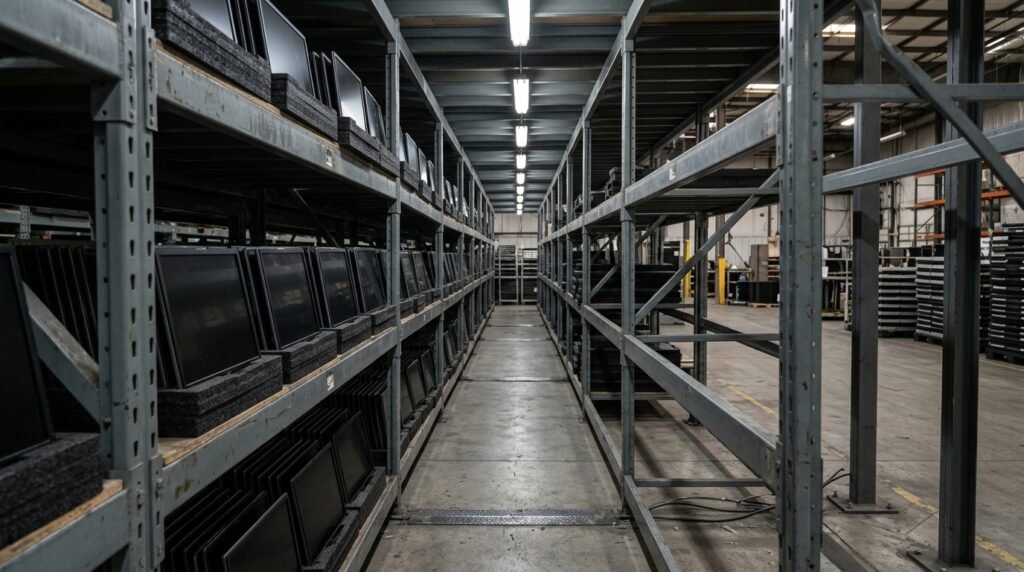
Order a replacement 17.3″ monitor today and you may not see it for ten weeks. Industrial monitor lead times 2026 have shifted from a same-week assumption to a planning problem. Omdia downgraded its 2026 global display demand forecast to a 6% unit decline in June 2026, pointing to geopolitical tension and rising component costs squeezing the supply chain. At the same time, panel trackers report mainstream LCD panel prices turning upward in early 2026 — the first increase in months — as a memory-chip shortage spreads through the display supply chain.
This isn’t a case for panic-buying. It’s a case for treating panel specification and ordering as a scheduling decision, not a last-minute purchase order. Below, we explain what’s actually changing, how IronView manages allocation across our 17.3″, 18.5″ and 19″ lines, and what to do differently if you’re specifying a replacement or new-build monitor right now.
Why Industrial Monitor Lead Times 2026 Are Stretching Out
Two data points explain the shift. First, Omdia’s June 2026 note downgrades global display unit demand for the year to a 6% decline, citing geopolitical tension and higher component costs as the pressure on supply. That’s a demand-side signal, but it changes supplier behaviour: fabs allocate capacity to their highest-volume sizes first. Mid-size industrial panels — the 17.3″, 18.5″ and 19″ ranges most plant equipment uses — sit further down that priority list than consumer TV and monitor sizes.
Second, a tracker report published on openpr.com shows mainstream LCD panel prices turning upward in early 2026 for the first time in months. The driver isn’t the panel makers themselves — it’s a memory-chip shortage spreading through the display supply chain, since every panel needs driver ICs and timing controllers built on the same constrained memory processes. When memory gets tight, panel makers wait for chips or pass the cost through. You see both outcomes on your quote: an LCD panel price increase 2026 buyers are already reporting, or a longer wait for the exact spec you asked for.
Put together, this is an industrial display panel shortage in the sense that matters to you: not empty warehouses, but allocation. Panel makers prioritise committed, high-volume orders. A one-off request for a 19″ panel in an uncommon aspect ratio now queues behind orders placed months earlier. The wider industrial monitor supply chain is absorbing that queueing pressure at every tier, from panel fab to integrator to you.

See also: Sealed Rear Connectors Panel Mount Monitor
What Longer Lead Times Mean for Your Project
The practical effect is less flexibility, not just a longer wait. When panel supply is loose, you can change a resolution or swap a resistive touch overlay for a projected-capacitive one two weeks before ship date and barely notice. When it’s tight, that same change can restart your position in the allocation queue. We’re seeing this most on non-standard aspect ratios and on brightness specs above 1,000 nits, where fewer panel variants are being run at all.
For a plant engineer, this changes the order of operations. Spec decisions that used to happen alongside the purchase order now need to happen before it, ideally as part of the same design review that fixes your enclosure cut-out and mounting bracket. If your panel specification is still open when you place the order, expect the quote to carry a wider lead-time range, not a fixed date.
How IronView Manages Panel Allocation Across 17.3″, 18.5″ and 19″ Lines
We pre-commit panel allocation on our core 17.3″, 18.5″ and 19″ panel mount range rather than buying spot on the open market. In practice that means: a standard-spec unit from one of these three sizes, requested today, ships in 3 to 5 working days from stock. A custom spec — a non-standard resolution, a brightness step outside our stocked bins, or a touch overlay we don’t hold pre-built — runs 8 to 12 weeks, and we’ve seen that stretch further when the requested panel size falls outside our committed allocation with the fab.
That gap between in-stock and custom lead times is the single biggest scheduling risk we see buyers underestimate. A 17.3″ replacement for an existing HMI cut-out is usually in-stock. A 19″ panel for a new machine build, in a resolution nobody has asked for before, is a custom order the moment you confirm it — and it competes for the same constrained memory-chip and driver-IC supply as everyone else’s custom order.
See also: Industrial Monitor Replacement: A Controlled Workflow
Four Steps to Protect Your Schedule
None of this requires overhauling your procurement process. It requires moving four decisions earlier.
- Lock your spec before you quote → resolution, brightness, touch technology and aspect ratio fixed at design review, not at purchase order stage.
- Avoid late resolution or touch-tech changes → a swap requested after the order is placed can push you to the back of a custom-build queue.
- Ask your supplier directly how they source panels → committed allocation versus spot-market buying is the difference between a 5-day and a 12-week answer.
- Request quotes before a unit fails → an emergency order after a failure has no lead-time cushion; a quote requested while the old unit still runs does.
FAQ
How much longer are industrial monitor lead times in 2026 compared with last year?
It depends on the spec. In-stock 17.3″, 18.5″ and 19″ units from IronView still ship in 3 to 5 working days. Custom specs that used to take 4 to 6 weeks are now commonly running 8 to 12 weeks, reflecting the panel and memory-chip supply pressure covered above.
Will LCD panel prices keep rising through 2026?
We can’t forecast that with confidence, and neither can most suppliers quoting you right now. What we can tell you: the early-2026 upward move reported by panel trackers is tied to memory-chip supply, not panel glass capacity, so pricing is likely to stay volatile rather than settle quickly.
Can I still get a fast turnaround on a standard-spec monitor?
Yes. Standard-spec units within our stocked 17.3″, 18.5″ and 19″ range are unaffected by custom-build queues. The risk sits specifically with non-standard resolutions, high-brightness variants and uncommon touch overlays.
Get Ahead of the Queue
If you’re specifying a monitor for a build that ships in three or six months, the right time to fix the spec and request pricing is now, while there’s still room to plan around a custom lead time rather than react to one. Contact IronView for a quote and we’ll tell you straight away whether your spec ships from stock or joins a custom production run — and give you a real date either way.


