
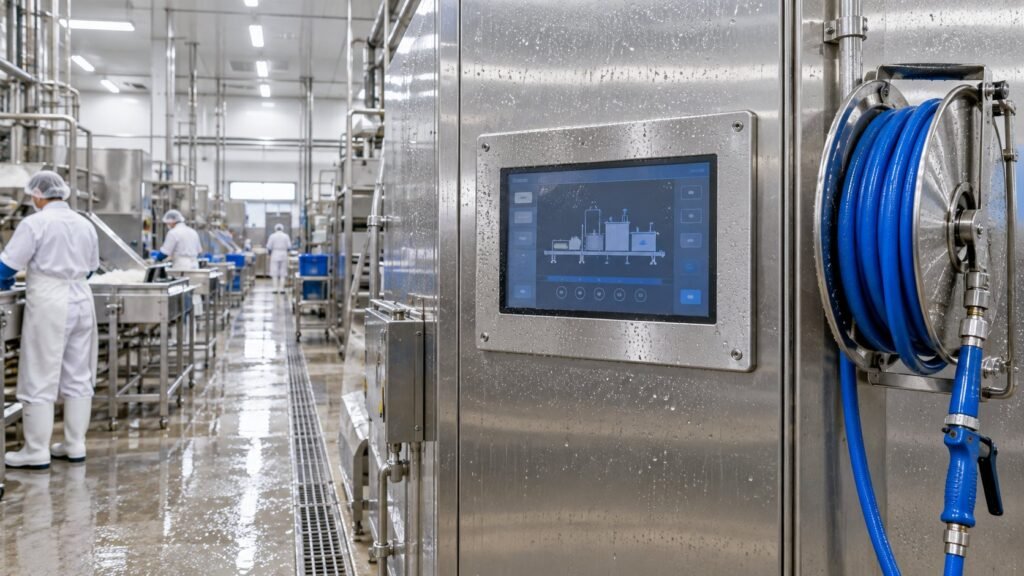
An ip69k washdown monitor only earns its keep if the whole assembly survives the wash cycle — not just the ingress test on a datasheet. Food and beverage lines clean daily with caustic or acid detergent, then rinse at up to 100°C and 80–100 bar. That combination strips paint, swells poor gaskets and finds every ledge where residue can sit. Engineer Live’s coverage of food-production monitors notes that washdown enclosures must withstand repeated cleaning and moisture exposure without corroding, and present a sanitary surface that resists contaminant build-up. That’s the bar an HMI on a filler, pasteuriser or CIP skid has to clear, shift after shift — not once, in a test chamber.
This guide skips the ingress-rating definitions — IP65 vs IP66 vs IP69K is already covered in our spec glossary. Here we stay on one decision: what to actually specify when you buy an ip69k washdown monitor for a real food or beverage line, not for a compliance report.
Why washdown areas destroy ordinary HMIs
A standard industrial monitor keeps dust and the odd splash out. A washdown station throws three things at it daily: caustic chemical exposure, high-pressure spray, and thermal shock from hot rinse water hitting a cold bezel. Engineer Live points to a further failure mode that has nothing to do with sealing — contamination. Seams, vents and painted joints give bacteria somewhere to hide, and auditors know exactly where to look. A monitor that leaks water eventually fails electrically. A monitor with a harbourage point can fail a hygiene audit long before that.

Stainless steel — and specifically SUS316
Painted mild steel enclosures corrode wherever the coating chips — and on a washdown line, something is always chipping it. That’s why a stainless steel washdown display is the default in this application, not an upgrade option. Grade matters: SUS304 handles routine splash and mild detergent, but SUS316 adds molybdenum, which resists the chlorides in caustic wash chemistry and the brine used in meat and dairy processing. Specify 316 wherever chlorinated CIP fluid or salt brine touches the enclosure directly. Beyond the alloy, check the build: a one-piece drawn or fully welded front with no exposed screw heads, radiused corners instead of butt-jointed panels, and a bezel with no gap for detergent to sit in and dry.
NEMA 4X and IP69K together — the real spec
IP69K on its own tells you the enclosure survived a close-range, high-temperature, high-pressure spray test — nothing more. It says nothing about long-term corrosion resistance, or how the enclosure holds up against a sustained chemical wash rather than a short test cycle. Things Embedded’s stainless monitor range makes the distinction clear in practice: its washdown-rated units pair IP66 or IP69K ingress with a 304 or 316 stainless chassis, because the ingress figure and the corrosion spec are separate claims. NEMA 4X is the enclosure standard that adds corrosion and sustained washdown resistance on top of the ingress number. Whether you’re speccing ip69k monitore for a German or EU line, or an ip69k washdown monitor for a US plant, ask the supplier for both ratings on the same datasheet — not IP69K alone with NEMA 4X assumed.
See also: What Is an IP65 Monitor? IP65 vs IP66 vs IP69K
The IP69K washdown monitor checklist
Run through this before you sign off any food and beverage HMI monitor for a washdown zone:
- Enclosure material — SUS316 for chlorinated CIP and brine exposure, SUS304 acceptable for lighter duty. Reject painted or powder-coated steel outright.
- Seal and gasket type — a single continuous silicone or EPDM gasket around the full bezel, not a segmented or four-point seal that leaves corners exposed.
- Glove-friendly PCAP touch — projected capacitive touch that reads through a wet, gloved finger, with the cover lens sealed edge-to-edge rather than taped on.
- Cable gland sealing — M12 A-coded connectors or fully potted glands, never a standard USB or HDMI port behind a snap cover.
- Flush mounting to the machine face — no lip, frame or standoff between bezel and panel. Every ledge is somewhere residue and standing water collect.
How IronView seals the 17.3″, 18.5″ and 19″ range for washdown duty
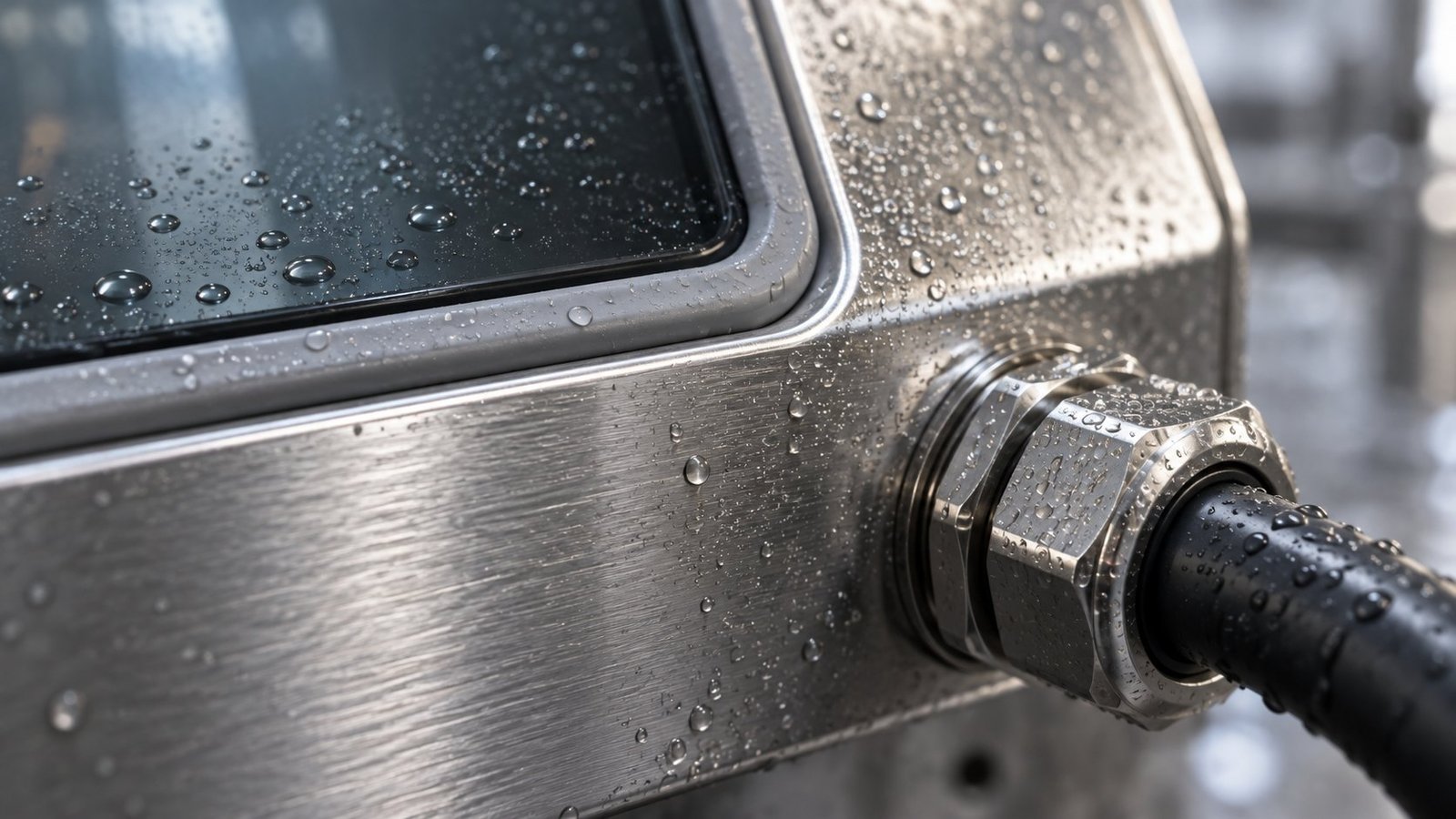
Our 17.3″, 18.5″ and 19″ monitors built for washdown installs use a one-piece SUS316 front with the touch glass bonded flush to the bezel — no recessed frame for water to pool in. Sealing runs on a single continuous silicone gasket compressed by a stainless clamp ring, not adhesive alone, so the seal holds after repeated compression cycles. Cabling exits through M12 A-coded connectors potted at the gland, and every unit is hose-tested per IEC 60529 at 80°C and 80–100 bar from 100–150 mm, across all nozzle angles, before it ships. For flush panel-mount installs we supply a stainless clamp frame sized to sit level with the machine face — no standoff, no lip, nothing for a CIP rinse to sit behind.
See also: Open Frame vs Panel Mount Monitor: How to Choose
FAQ
Do I need IP69K if the line only gets a daily rinse, not a full caustic wash?
If the rinse is low-pressure and cold, IP66 may be enough. The moment you add a hot, high-pressure hose or a caustic CIP cycle, specify IP69K with a NEMA 4X-rated stainless enclosure — retrofitting after a failure costs more than speccing it correctly the first time.
Is 316 stainless always necessary, or is 304 enough?
304 resists general moisture and mild detergent. Specify 316 wherever chlorinated CIP fluid, brine or salt-based cleaning agents touch the housing directly — dairy, meat, seafood and brine-heavy beverage lines all qualify.
Does IP69K alone guarantee NEMA 4X compliance?
No. IP69K certifies that the enclosure survived a defined spray test. NEMA 4X additionally covers corrosion resistance and sustained washdown exposure. Ask for both ratings on the datasheet, not one implying the other.
Specify the enclosure, not just the rating
An ip69k washdown monitor is only as good as its weakest seam — the gasket, the gland, or the ledge where the mount meets the machine face. Get the enclosure grade, the seal and the mounting right, and the ingress rating on the datasheet actually means something on the plant floor. Browse our washdown-rated stainless steel touch screen monitors in the 17.3″, 18.5″ and 19″ range, or talk through your line’s wash cycle with our team before you specify. →


